OUR THERAPEUTIC APPROACH
Welcome to Harmony Care Group
At Harmony Care Group, our therapeutic approach recognises that many children and young people living in residential care have experienced trauma, disrupted attachments, loss or adversity. These experiences can significantly affect how children understand relationships, manage emotions and respond to the world around them.
Our role is to provide safe, nurturing and predictable homes where children feel emotionally contained, understood and supported to heal, develop resilience and achieve positive outcomes.
Therapeutic care at Harmony Care Group is not limited to formal therapy sessions. Instead, it is embedded into everyday interactions, routines and relationships, ensuring that children experience care that is consistent, attuned and developmentally appropriate.
A Trauma-Informed, Relationship-Based Model
Our therapeutic model is grounded in trauma-informed and attachment-aware practice, recognising that behaviour is often a form of communication rather than deliberate defiance.
We understand that children may display behaviours that reflect fear, unmet needs or past experiences. Our response focuses on understanding why a behaviour is occurring, rather than simply managing the behaviour itself.
Central to this approach is the PACE model, which guides how our staff build and maintain therapeutic relationships with children.
The PACE Model in Practice
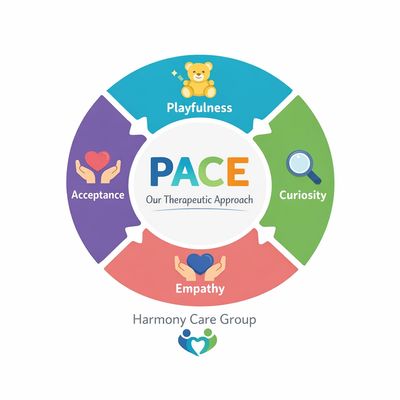
PACE stands for Playfulness, Acceptance, Curiosity and Empathy. It underpins how staff at Harmony Care Group interact with children on a daily basis.
Playfulness
Playfulness helps reduce anxiety, build connection and create positive experiences. It does not mean being flippant or dismissive, but using appropriate warmth, humour and lightness to help children feel safe and engaged.
Acceptance
Acceptance means acknowledging a child’s feelings, experiences and emotional responses without judgement. Staff separate the child from their behaviour, helping children feel accepted even when their behaviour needs to be addressed.
Curiosity
Curiosity encourages staff to explore what lies beneath a child’s behaviour. Rather than assuming intent, staff seek to understand the child’s perspective, experiences and unmet needs through calm, reflective conversations.
Empathy
Empathy involves communicating understanding and compassion for how a child may be feeling. It helps children feel emotionally held and understood, reducing shame and supporting emotional regulation.
By consistently applying PACE, staff create relationships built on trust, safety and emotional connection.
Everyday Therapeutic Care
Therapeutic care at Harmony Care Group is embedded into daily life within the home. Children experience therapy through:
- Predictable routines that create emotional safety
- Calm, consistent adult responses
- Clear boundaries delivered with warmth and respect
- Opportunities for reflection, repair and reassurance
- Support to develop emotional literacy and self-regulation
This approach allows children to gradually build confidence, trust adults and experience stability.
Individualised Therapeutic Planning
Each child is supported through an individualised care and therapeutic plan, developed in partnership with the child, placing authority and relevant professionals.
Plans are informed by:
- The child’s history and lived experiences
- Identified emotional, behavioural and developmental needs
- Risk assessments and safeguarding considerations
- Education, health and therapeutic input
- The child’s wishes, feelings and aspirations
Plans are regularly reviewed to ensure they remain responsive and outcome-focused.
Supporting Emotional Regulation and Resilience
Through our therapeutic approach, children are supported to develop:
- Emotional awareness and regulation skills
- Healthy coping strategies
- Improved communication and problem-solving abilities
- Confidence and self-esteem
- Positive and secure relationships
Staff use co-regulation, reflective conversations, restorative approaches and positive reinforcement to support children’s emotional growth.
Multi-Disciplinary Working
Harmony Care Group works collaboratively with a range of professionals to ensure holistic support, including:
- Social Workers and Independent Reviewing Officers
- CAMHS and mental health services
- Psychologists and therapists (where appropriate)
- Education providers and Virtual Schools
- Health professionals
This ensures that therapeutic care is consistent, coordinated and aligned with wider care planning.
Skilled and Supported Staff Teams
Our therapeutic approach is delivered by trained, reflective and well-supported staff.
We ensure:
- Comprehensive induction and ongoing trauma-informed training
- Regular supervision and reflective practice
- Clear guidance on applying the PACE model in everyday care
- Support for staff wellbeing and emotional resilience
We recognise that emotionally supported staff are better able to provide high-quality therapeutic care.
Positive Outcomes and Preparation for the Future
The ultimate aim of our therapeutic approach is to support children to:
- Feel safe, valued and understood
- Develop trust in adults and relationships
- Engage positively in education and daily life
- Build independence and life skills
- Move forward with confidence and hope
We focus on long-term emotional wellbeing and sustainable outcomes, not short-term behaviour management.
Our Commitment
Harmony Care Group is committed to providing care that is:
- Child-centred
- Trauma-informed
- Guided by the PACE model
- Evidence-based
- Outcome-focused
Our therapeutic approach underpins everything we do and reflects our commitment to creating homes where children can truly thrive.